
Rounding clock-in times: what's allowed in Quebec and Ontario.
An employee clocks in at 7:53 and out at 4:08. Do you pay from 7:53, from 8:00, or from 7:45? Rounding makes timesheets easier to read, but done the wrong way it quietly takes minutes off every shift. Here is what the rules say, the trap to avoid, and a simple way to check your own setup.
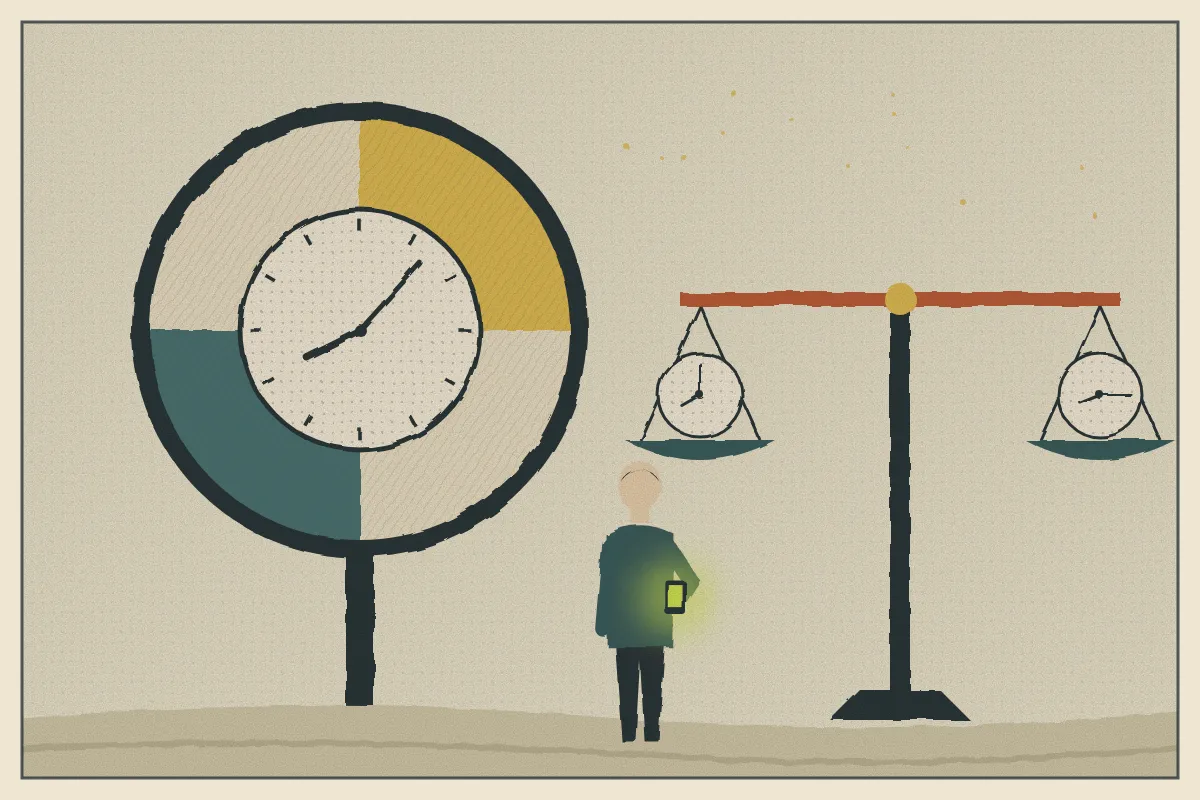
What the rules say in Quebec and Ontario
We found no written rule on rounding in the Quebec or Ontario texts we read. What they do set is the principle behind it: the time worked is what counts. In Quebec, the Act respecting labour standards (section 57) says an employee is deemed to be at work when they are at the employer's disposal at the workplace, during breaks granted by the employer, during travel the employer requires, and during required training.
Both provinces also require records. In Quebec, the regulation on the registration system asks for the number of hours worked each day and each week, kept for 3 years. In Ontario, the employer must record the dates and times the employee worked and the hours worked each day and each week, also kept for 3 years. If a complaint comes, those records are what you will show.
Rounding to the nearest, or always in your favour
There are two very different ways to round. Rounding to the nearest quarter hour moves 8:07 to 8:00 and 8:08 to 8:15. Sometimes the employee gains a few minutes, sometimes you do, and over a month it should roughly even out.
Rounding in one direction is another story. If arrivals always go up to the next quarter and departures always go down, an arrival at 8:01 counts as 8:15 and a departure at 4:14 counts as 4:00. That's 28 minutes of work unpaid in a single day, more than two hours in a five-day week, for every employee.
For a reference point, the US federal rule (29 CFR 785.48) accepts rounding to the nearest 5 minutes, tenth or quarter of an hour, as long as it does not, over time, fail to pay employees for all the time they actually worked. It does not apply in Canada, but it describes the test well.
Three traps that cost minutes
- Early arrivals that are actually work. Not paying before the start time is fine when the employee just arrived early. If they open the store, set up or answer the phone, that time is work and is owed.
- Rounded breaks. A 30-minute unpaid break rounded to 45 takes 15 minutes from the workday. Breaks deserve the same neutral rounding as arrivals and departures, or none at all.
- The overtime threshold. A few minutes rounded down each day can keep someone just under 40 hours in Quebec or 44 in Ontario, and change the rate of the last hours.
How to check that your rounding is neutral
- Keep the real times. Rounding should be applied to the timesheet, never to the original clock-in. Without the real times, you can't prove anything.
- Compare once a month. Total the real hours and the rounded hours for each employee. The gap should be small and go both ways.
- Watch for the same names. If the same people always lose minutes, the rule or the schedule is not neutral for them.
- Write it down. Put the rounding rule in your policy, in one sentence, so everyone knows how their hours are counted.
This article gives general information, not legal advice. Your sector, a collective agreement or an averaging agreement may set other rules.
How KLOKUP does it
Rounding is off by default. In Settings, under Pay rules, you can round clock-ins to the nearest 5, 10, 15 or 30 minutes: always to the nearest, never in one direction, and the same way for arrivals, breaks and departures. The rule is applied to timesheets, reports and the payroll export; the original clock-ins are never changed. The Hours page reminds you which rules are on, and every manual correction is kept in a history with its reason.
A separate option, also off by default, pays early arrivals from the scheduled start time. Turn it on only if arriving early is not work in your business.
Try it with your team
KLOKUP is free up to 10 employees, with no credit card. Your team clocks in from their own phone today.
Keep reading
 CostsBadge time clock or phone app: the real costClock, badges, subscription, hidden costs: how a badge time clock compares with a phone app over three years, with prices checked online.
 ScheduleHow to fill open shifts without twenty phone callsPost an open shift once, let available employees take it from their phone, and keep overtime and fairness under control.
 Clocking inHow to stop employees from clocking in for each otherWhy employees clock in for each other, six simple ways to stop it, and why a fingerprint clock is rarely the answer in Quebec.